Peru Regions - The Amazon
By far the country’s largest region, the Amazon, comprises 63% of Peru’s territory, stretching from the cloud forests on the eastern slopes of the Andes, north to the borders of Ecuador and Colombia, and east to Brazil and Bolivia. It consists of immense Loreto Department that until 1942 belonged to Ecuador, plus the departments of Ucayali and Madre de Dios and the eastern portion of the Amazonas department. The most bio-diverse region in the world, the Peru Amazon Rainforest is home to some 2,000 fish species, 400 mammal species, 1,800 birds and 300 reptiles. The Amazon is mineral-rich with an abundance of oil, natural gas and precious metals, as well as being a source of products for a thriving coca trade that ends up in illegal export and is used in traditional medicine.
Return to Previous Page
-
The Cities
-
The Amazon is dotted with riverside villages, indigenous settlements and few population centers of any magnitude. The region’s largest city is the port of Iquitos, with a population of 400,000, located over 2,000 miles inland from the Atlantic. Offering a convenient base for river and rainforest travels, eco-lodge accommodations here range from basic to luxury. The region's inaccessibility more or less protected the Amazon from intruders such as the Incas and conquistadors until the rubber boom of the late 1800s transformed Iquitos into a colonial haven for speculators who became wealthy off the labor of the native Amazonians. The nouveau riche left a now dilapidating legacy of palatial homes that nature relentlessly works to re-claim. One of the city's unique sights is the floating neighborhood of Belen with a colorful market and houses built on stilts and rafts. Southern Explorations offers a four to eight-day M/V Aqua - Amazon River Expedition from Iquitos aboard a luxury riverboat.
-
The Amazon's only other large city is Pucallpa, made so by the completion of the highway from Lima. Its location along the Ucayali River has made it a thriving industrial hub with a population of 205,000. Its chief sights are the Chullachachaqui Botanical Gardens and Lake Yarinacocha. It is also the site of the Usko Ayar Amazonian School of Painting that attracts students from throughout the world for art and Spanish classes. Though located 300 miles south of Iquitos, it lies 500 miles upstream. The Alexander von Humboldt and Biabo-Cordillera Azul National Forests are nearby.
-
Situated at the confluence of the Madre de Dios and Tambopata rivers, the frontier town of Puerto Maldonado is mostly a stopping off place for visitors on Peru tours heading into the rainforest.
-
Recreation
-
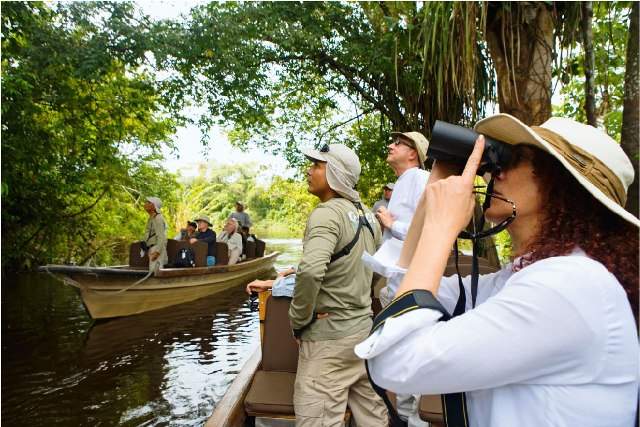
Recreation in the Amazon consists mainly of paddling the tributaries and Amazon in search of wildlife, hikes through the rainforest and napping in a hammock to escape the midday heat. The Peru Amazon contains several government-protected areas. The Pacaya Samira National Reserve, south of Iquitos, is located at the confluence of the Maranon and Ucayali rivers. Stretching over 7,000 square miles, it is a good place to spot the largest species of river dolphin, pinkish in color, called the boto. Those looking for more action while in the area on Peru tours may wish to do some whitewater rafting down the Tambopata River through lush tropical rainforest scenery and Class III and IV rapids. A seven to twelve day trip starts in Putina Punku. If a white sand beach along the world's mightiest river sounds exotic, the small Allpahuayo-Mishana National Reserve fourteen miles south of Iquitos is the place to go.
-
In the southern Peru Amazon, the Madres de Dios region offers visitors a choice of two magnificent areas to explore in their Peru travel. The Manu, just fifty-five miles north of Cusco (but a two-day overland jaunt), is the world's most bio-diverse national park, 4.5 million pristine acres where visitor travel is tightly controlled. Contiguous with the Manu and near the Brazilian border, 6.2 million-acre Alto Purus National Park was established in 2004 to protect the giant river otter, Harpy eagle and other endangered species as well as the big leaf mahogany tree. The park also protects the many indigenous populations living in the area. Further east is Bahuaja-Sonene National Park, site of Peru's only tropical savannah, where no visitors are allowed. Contiguous to the park is the Tambopata National Reserve, a major tourist attraction, that border Bolivia's Madidi National Park.
-
Events
-
In February, Ucayali holds the biggest of the region's Carnival celebrations with dance competitions, parades and much music. In June, Ucayli (and elsewhere in the Peru Amazon) is the site of the Festival of San Juan (John the Baptist’s Day), an agriculture and craft fair with cultural shows.
-
Southern Explorations offers tours to the Peru Amazon and the Ecuador Amazon. Its Peru Amazon tours say in the rainforest from two to eight days and visit one of three areas, the northern Amazon around Iquitos, Manu National Park or the Tambopata Amazon tributaries bordering Bolivia. Other than the Iquitos riverboat trip, our Peru Amazon tours use eco-lodge accommodations in the rainforest.
-
Our tours that visit the Tambopata area combine the Amazon with one or more of Peru’s other top attractions such as Machu Picchu, Lake Titicaca and the Colca Canyon: the nine-day Amazon & Machu Picchu Tour, the ten-day Luxury Peru & Amazon Tour, the eleven-day Peru Highlights Tour, the twelve-day Amazon & Inca Trail Tour, the fourteen-day Best of Peru Tour, the fourteen-day Discover Peru Tour and the eighteen-day Adventure Peru Tour. Our two to eight-day Amazon tour extensions are a convenient way to add a rainforest experience to your Peru tours to visit Manu National Park, the Tambopata or Iquitos.
-
Terrain and Weather
-
The distance from the Andes to the Amazon Rainforest is surprisingly short, allowing international visitors on Peru tours to hike the Inca Trail to Machu Picchu and travel down the Amazon, all in one glorious trip. Areas closest to the equator have less weather variation between seasons, unlike the south that experiences high humidity year-round but has a rainy season from November to March and a drier season the rest of the year. Though the northeast region of the Peru Amazon does not have a rainy season, the river still floods annually. Most visitors on their Peru travel to the southeast region of the Peru Amazon reach this lowland subtropical forest by flying into Puerto Maldonado during the dry season from May through October.